
Blended Learning and Coaching LMS


A market-informed platform model for structured learning, live facilitation, workplace practice and measurable progress
Proposed architecture — not a delivered LMS client case
Keywords: Learning Management System; blended learning; leadership development; coaching; cohorts; facilitated learning; workplace practice; progress reporting; Sampark; WebRTC; application evidence.
This is not presented as a completed LMS customer engagement. Proposed capabilities, architecture and pilot measures are labelled accordingly; verified NoteG delivery proof is identified separately.
Abstract
From isolated online meetings to a measurable applied-learning journey
Many training organisations can move a live session online quickly. The harder task is preserving the complete learning experience: preparation before the session, active participation during it, practice afterwards, facilitator feedback and evidence that behaviour is changing.
This reference solution defines an LMS that coordinates those activities across learners, facilitators and programme administrators. It can begin with existing meeting tools and a focused pilot. Deeper live-session integration through NoteG's Sampark layer is optional and should be introduced only when branding, access control, low-bandwidth performance or integrated session data creates clear value.
The study translates patterns documented by established LMS vendors into a practical NoteG architecture. The emphasis is not on maximum feature count. It is on a defensible minimum system that can preserve the human element of facilitated learning and create a traceable journey from enrolment to workplace action.
| Lens | What it shows |
|---|---|
| Market pattern | Structured paths can combine courses, classrooms, assessments, required steps, due dates and completion logic. |
| NoteG foundation | Training workflows, attendance, results, certification, feedback, dashboards, multi-role portals and integrations. |
| Delivery proof | Sampark and Tele-Law demonstrate real-time platform engineering, recording, reporting and operation at significant scale. |
1. Background and delivery context
Blended learning is an operating model, not a video-call substitution
A learning provider moving beyond on-site delivery must coordinate more than the live session. Participants need a clear journey, facilitators need visibility into preparation and follow-through, and administrators need consistent programme operations across cohorts, clients and regions.
The reference model assumes that a proven workshop or coaching programme remains the intellectual core. Technology supplies the operating layer around it: access, sequencing, reminders, live-session links, practice evidence, feedback, completion rules and reporting.
| Role | Needs |
|---|---|
| Learner | A simple path showing what to do before, during and after each facilitated session. |
| Facilitator or coach | Context on participant preparation, a place to review application work and a practical cohort view. |
| Programme administrator | Enrolment, scheduling, role management, communications, progress and reporting in one operating view. |
| Client sponsor or manager | Agreed visibility into participation, completion and workplace application without intrusive monitoring. |
| NoteG LMS core | Coordinates the journey and maintains the programme record while existing live-delivery tools can remain in place initially. |
Boundary condition: the platform should strengthen the programme model without turning coaching into automated content consumption. Human judgement, facilitated challenge and real workplace application remain primary.
2. Problem statement and design challenge
Why a conventional content-first LMS can miss the point
Leadership and coaching outcomes depend on interaction, reflection, feedback and action in context. A platform that measures only video views and quiz completion may create administrative order without preserving the conditions that make the programme valuable.
| Challenge area | Operational meaning |
|---|---|
| Fragmented learner journey | Materials, meeting links, reminders, assignments and feedback can spread across email, drives and separate tools. |
| Loss of facilitated continuity | A live session becomes a standalone event rather than one step in a connected learning sequence. |
| Weak between-session reinforcement | Agreed actions may not be prompted, captured, reviewed or connected to the next session. |
| Limited cohort visibility | Facilitators may not know who prepared, who is stuck or where the cohort needs attention. |
| Completion without application | A system can show content completion while providing little evidence of workplace use. |
| Premature platform complexity | Buying or building too much before validating the programme workflow can increase cost and adoption friction. |
The design problem is to create enough structure to make blended delivery consistent and measurable while protecting the human, contextual and practice-led nature of the programme. The first release must therefore prioritise journey coherence and facilitator usefulness over a long feature list.
3. Reference scope and platform components
The NoteG LMS as the programme operating layer
The proposed platform brings learning design, cohort operations and evidence into one branded environment. Capabilities below are a design scope, not a claim that all modules have already been deployed for an LMS customer.
| Reference component | Purpose and value |
|---|---|
| Programme and pathway builder | Organises modules, required and optional activities, prerequisites, live sessions and completion rules. |
| Cohort and role management | Controls learner, facilitator, administrator and sponsor access by programme and group. |
| Content and activity layer | Supports reading, video, downloads, reflection prompts, assignments and assessments. |
| Live-session coordination | Publishes dates and access links, records attendance and connects preparation with follow-through. |
| Practice and feedback workflow | Captures workplace actions or evidence and routes them to the right facilitator for response. |
| Progress and completion | Shows required steps, status, results, certificates and renewal rules where relevant. |
| Reporting and notifications | Provides cohort visibility, reminders, exceptions, exports and configurable programme reports. |
| Integration layer | Connects meeting tools, Sampark, identity, HRMS, CRM, email and approved APIs. |
4. Solution architecture
A modular platform that can begin with existing tools
The architecture separates experience, learning logic, data and integrations. This lets an initial pilot keep Google Meet or Microsoft Teams while NoteG validates the learning journey. Sampark can be introduced later if embedded delivery or deeper session control becomes valuable.
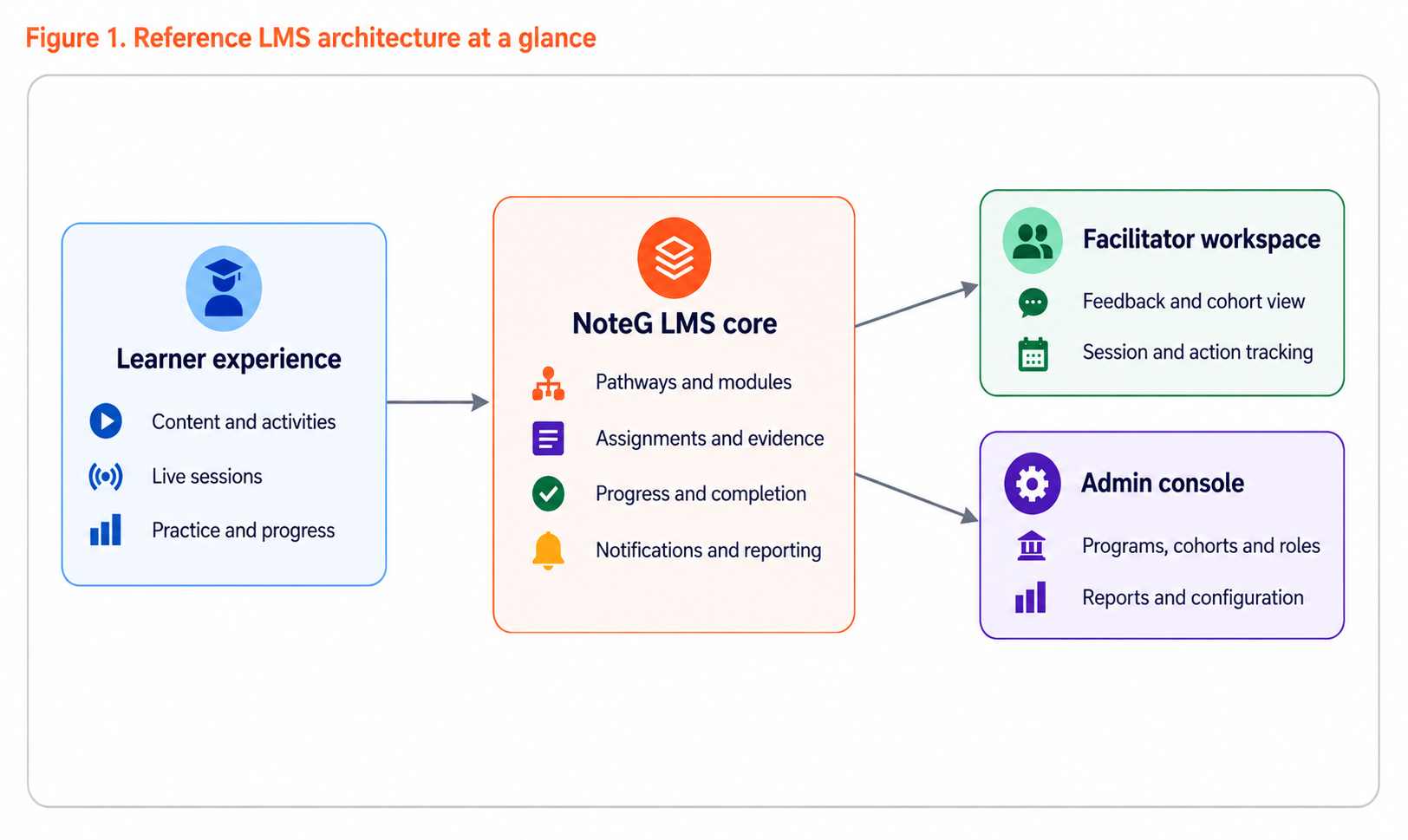
Reference LMS architecture at a glance
- Learner experience: content and activities, live sessions, practice and progress
- Facilitator workspace: feedback and cohort view, session and action tracking
- Admin console: programs, cohorts and roles, reports and configuration
- NoteG LMS core: pathways and modules, assignments and evidence, progress and completion, notifications and reporting
- Integration layer: Google Meet or Teams, Sampark, HRMS or SSO, email, APIs
| Architecture layer | What it does | Status |
|---|---|---|
| Experience | Branded learner portal, facilitator workspace and administrator console. | Proposed LMS |
| Learning | Pathways, content, activities, live sessions, feedback and completion logic. | Proposed LMS |
| Intelligence | Progress, attendance, engagement, exceptions, evidence and exports. | Proposed LMS |
| Integration | Google Meet/Teams, Sampark, HRMS/SSO, email and APIs. | Phased |
| Real-time | Embedded audio/video, session control, recording and operational data. | Sampark option |
Architecture principle: keep the core learning record independent of the live-session provider. This reduces migration risk and prevents a meeting-tool decision from blocking the pilot.
5. End-to-end learning workflow
How one programme moves from enrolment to workplace action
The workflow is designed so that every live session sits inside a coherent sequence. The learner experience remains simple while facilitators and administrators gain the context needed to support participation and follow-through.
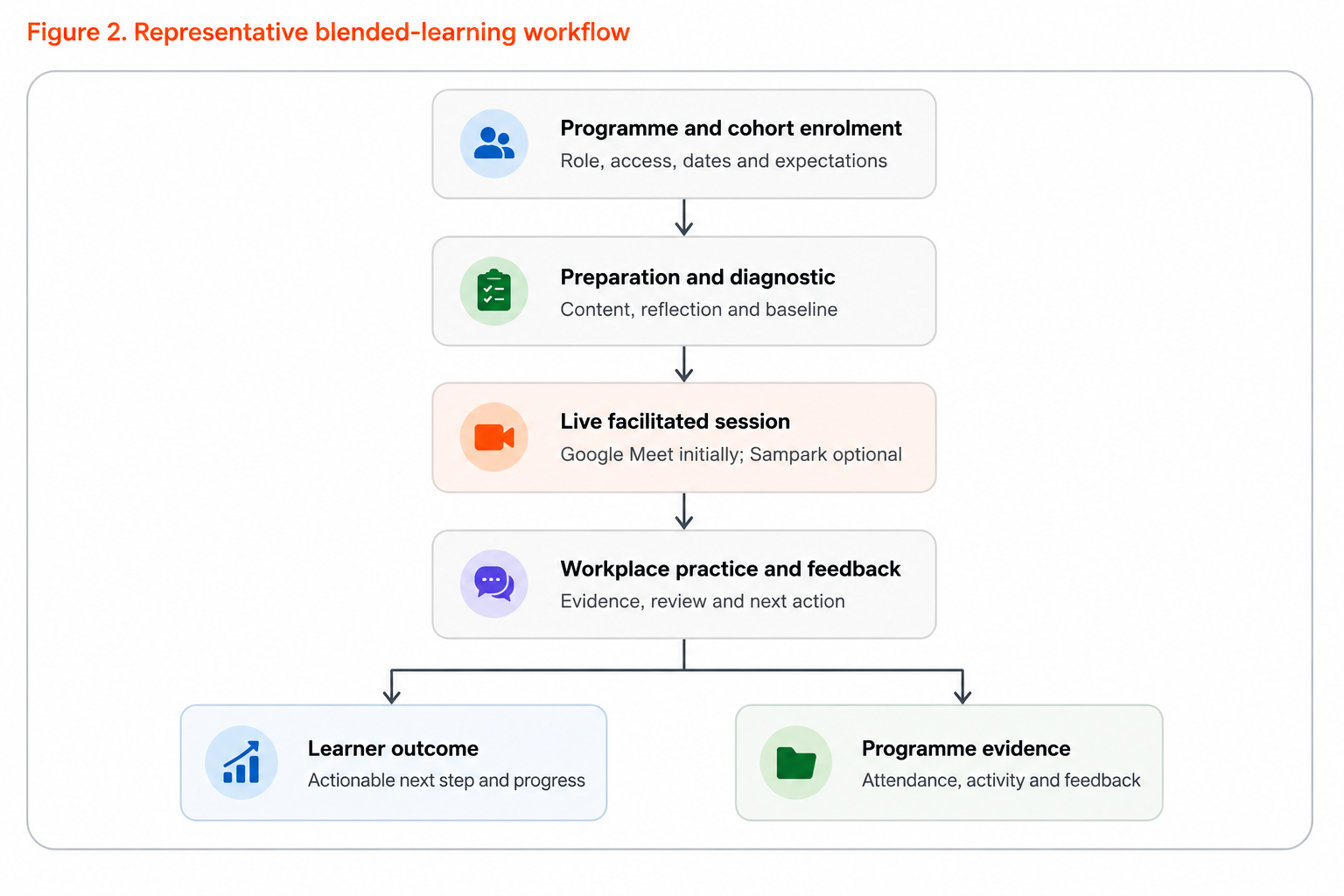
- 1Administrator enrols the participant into the correct programme, cohort and role.
- 2Learner completes preparation; facilitator can see readiness before the live session.
- 3The live session is delivered through the chosen meeting layer and attendance is recorded.
- 4Learner applies an agreed action at work and submits reflection or evidence.
- 5Facilitator responds; the platform updates progress and prompts the next meaningful step.
6. Implementation methodology
Pilot the learning journey before scaling the platform
The recommended methodology is programme-first. NoteG begins with one representative learning journey, configures only the capabilities required to run it and uses observed behaviour to decide what should be expanded, integrated or removed.
| Method principle | Practical response |
|---|---|
| Start with one real programme | Map its roles, sequence, live moments, between-session actions and completion definition. |
| Preserve current delivery | Keep existing facilitation practice and meeting tools unless a change is necessary for the pilot. |
| Build the smallest coherent journey | Prioritise enrolment, pathway, live coordination, practice, feedback and basic reporting. |
| Instrument the workflow | Capture the limited set of events needed to evaluate engagement, facilitator effort and operational friction. |
| Review before expansion | Use pilot evidence to decide on certificates, client portals, automation, Sampark and deeper integrations. |
| Requirement | Design response |
|---|---|
| Facilitated learning remains central | Live sessions and facilitator judgement remain first-class steps in the pathway. |
| Application matters more than consumption | Completion rules can include practice evidence and feedback, not only content views. |
| Low change burden | Existing meeting tools and programme content can remain during the first pilot. |
| Evidence without surveillance | Collect agreed programme events and outcomes with role-based visibility. |
| Future scale | Use modular services, configurable roles and APIs so capability can expand by evidence. |
7. Governance, reporting and security
Making learning measurable without over-collecting data
A credible learning platform must distinguish useful programme evidence from unnecessary surveillance. Data collection should be tied to an agreed decision: supporting a learner, improving a cohort, demonstrating completion or operating the service reliably.
| Governance layer | Function |
|---|---|
| Role-based access | Limits learner, facilitator, administrator and sponsor views to the information each role requires. |
| Programme record | Maintains enrolment, activities, attendance, feedback, status and completion in a traceable structure. |
| Consent and transparency | Explains what is recorded, why it is recorded and who can access it, especially for live sessions. |
| Configurable retention | Applies agreed retention rules to submissions, recordings, reports and exports. |
| Operational reporting | Shows cohort participation, overdue actions, facilitator queues, completion and selected outcome measures. |
| Security controls | Supports secure authentication, least-privilege access, encryption, logs, backups and environment controls as scoped. |
Dashboards should answer concrete operating questions: Who needs support? Which activity causes drop-off? Where is facilitator review delayed? Is workplace practice being completed? Are different cohorts receiving a consistent journey?
8. Pilot measurement framework
Proposed measures — not claimed results
Because this is a reference solution rather than a completed LMS engagement, the responsible approach is to define what a pilot should measure instead of inventing outcomes. Baselines and targets should be agreed with the programme owner before launch.
| Evaluation dimension | Suggested measure | Decision it supports |
|---|---|---|
| Learner readiness | Required preparation completed before each live session. | Whether the pathway improves session readiness. |
| Live participation | Attendance plus agreed participation signals. | Whether blended access supports consistent participation. |
| Workplace application | Actions submitted, reviewed and carried forward. | Whether learning extends beyond the session. |
| Facilitator usefulness | Review time, visibility and qualitative feedback. | Whether the system helps rather than burdens facilitators. |
| Operational effort | Time spent on enrolment, reminders, chasing and reporting. | Which workflows merit automation. |
| Cohort consistency | Variation in activity, feedback turnaround and completion. | Where programme delivery needs refinement. |
| User experience | Short learner and facilitator feedback at key moments. | Whether navigation and prompts are clear. |
Success gate: expand only if the pilot shows that the LMS creates a clearer journey, more useful follow-through or lower operating friction without weakening the live learning experience. If it does not, revise the workflow before adding features.
9. Supporting delivery proof
What NoteG has already demonstrated
The evidence below does not claim a completed LMS customer programme. It shows that the component capabilities required for a credible LMS are grounded in existing NoteG products and a verified high-stakes platform engagement.
| Evidence source | Verified capability | Relevance to the LMS |
|---|---|---|
| NoteG HRMS — Training and Development | Programmes and events, schedules and trainers, invitations and attendance, results and certification, feedback and skill-gap-led planning. | Provides direct foundations for programme administration, progress and completion workflows. |
| Sampark real-time communication | Embeddable real-time audio/video capability, platform integration, session controls and operational records. | Provides an optional branded live-learning layer when external meeting links become limiting. |
| Tele-Law — Department of Justice, Ministry of Law and Justice, Government of India | Sampark delivered in 2025 as a production consultation layer supporting multilingual delivery, 2G/3G environments, recording and reporting; approximately 250,000 monthly active users and 10,000 calls per day. | Demonstrates real-time engineering, scale, constrained-network delivery, traceability and reporting. |
| Custom application delivery | Multi-role portals, workflow automation, dashboards, reporting, integrations and managed product engineering. | Supports the learner, facilitator and administrator experiences around the LMS core. |
10. Conclusion and recommended evaluation
A credible next step is a working demonstration, not a platform commitment
The reference study shows how NoteG can create a coherent blended-learning operating layer around a facilitator-led programme. Its credibility rests on transparent scope: the LMS architecture is proposed; the supporting NoteG capabilities and Tele-Law delivery proof are identified separately; and pilot outcomes are defined as measures rather than presented as achievements.
For a learning provider testing online coaching or training, the next decision is not whether to purchase a large LMS. It is whether one representative programme can be modelled clearly enough to demonstrate value for learners, facilitators and administrators.
- Core solution proof: a complete journey can connect preparation, live facilitation, workplace practice, feedback and progress.
- Capability proof: NoteG already holds relevant training workflow, application, dashboard, integration and real-time communication foundations.
- Risk-control proof: the design can retain existing meeting tools and validate one programme before deeper integration.
- Recommended evaluation: a 30-minute working demonstration using one representative leadership or coaching journey.
Research basis: official market references reviewed 6 August 2026 (Docebo learning plans and certifications; 360Learning paths; LearnUpon portals and reporting). Internal capability basis: NoteG HRMS Training and Development, Sampark product capability, and supplied Tele-Law case records.
Proposed next step
Review one programme end to end in a 30-minute LMS demonstration. If the journey fits, define a small pilot cohort, its success measures and the minimum configuration required.
Join Our Newsletter & Get updated.
We only send interesting and relevant emails.
We deliver reliable technology solutions for clients across India and international markets. All engagements are governed by clear contracts and service-level agreements defining scope, timelines, and responsibilities.