
Tele-Law: Real-Time Legal Consultations for Rural India


Sampark video consultation layer for the Department of Justice, Ministry of Law & Justice, Government of India
Named public engagement — delivered in 2025 and still running in production
Keywords: Tele-Law; real-time consultation; access to justice; rural India; CSC; low-bandwidth video; Sampark; government digital infrastructure; session recording; program reporting.
This is a named, public engagement. Unlike NDA-bound work, the case can name the Department of Justice, Ministry of Law & Justice, Government of India, as stated in the supplied source material.
Abstract
A last-mile legal access platform built for real network conditions
India's Tele-Law program addresses a critical access-to-justice challenge: citizens in rural and remote communities often face travel, cost and time barriers when seeking basic legal advice. The program connects citizens at village-level Common Service Centres (CSCs) with panel lawyers through video consultation or telephone, extending legal access closer to the doorstep of the citizen.
The engineering challenge is unusually demanding. The areas that benefit most from Tele-Law are also the areas where conventional real-time video systems are most likely to fail: 2G/3G village networks, shared and unstable connectivity, low-end devices and multilingual usage. NoteG Technologies delivered Sampark as the live video consultation layer, with session recording and reporting, to keep consultations usable and accountable under those constraints.
This case study demonstrates how a real-time communication layer can be designed for public-service delivery where network reliability, low-cost access devices, multilingual participation and government accountability are first-class requirements rather than secondary optimizations.
1. Background and program context
Tele-Law as public digital justice infrastructure
Tele-Law is an access-to-justice initiative of the Department of Justice, Ministry of Law & Justice, Government of India. It works in partnership with NALSA and CSC e-Governance Services India to provide legal information and advice to marginalized and rural communities through communications technology.
The operating model is deliberately last-mile oriented. A citizen visits a local Common Service Centre at the gram panchayat level. A Village Level Entrepreneur assists with registration and case intake. The citizen is then connected with a panel lawyer for a live consultation by video conferencing or telephone.
| Actor | Role |
|---|---|
| Citizen | Seeks legal advice without travelling long distances or losing work days. |
| Common Service Centre (CSC) | Local digital service access point at village or gram panchayat level. |
| Village Level Entrepreneur (VLE) | Assists the citizen with matter registration and consultation access. |
| Panel lawyer | Provides live legal advice through the consultation channel. |
| Department of Justice ecosystem | Monitors program operations, quality, reporting and service delivery. |
| Sampark by NoteG Technologies | Powers the live video consultation, recording and reporting layer. |
2. Problem statement and engineering challenge
Why rural legal video consultation is a hard real-time problem
The project was not simply a video integration. It required a consultation layer that could work under the exact conditions where consumer-grade video products generally break. In a public justice context, a failed call can mean a citizen loses access to advice for that day.
| Challenge area | Operational meaning |
|---|---|
| 2G/3G village networks | Rural and remote access points often operate on weak, unstable and shared networks. |
| Low-end devices | The platform had to run on modest hardware at village access points without heavy CPU, memory or battery demands. |
| Multilingual reality | Consultations occur across many languages and must support diverse citizen participation. |
| Mission reliability | A failed video call undermines the promise of the program for a citizen who may have travelled to the CSC. |
| National concurrency | The platform had to support high active usage and thousands of consultations every working day. |
| Government accountability | Recording and structured reporting were required for monitoring, auditability and program improvement. |
The core engineering problem was to make legal consultations complete reliably where network quality, device capability and language diversity could not be assumed. The system therefore needed to prioritize continuity of consultation over cosmetic video quality.
3. Engagement scope and delivered components
Sampark as the consultation backbone
NoteG Technologies was awarded the project to deliver the real-time backbone of the Tele-Law consultation experience. The delivered layer connected citizens and panel lawyers while also enabling consultation recording and reporting for program administrators.
| Delivered component | Purpose and value |
|---|---|
| Sampark video consultation layer | Live real-time connection between citizens at CSCs and panel lawyers across the country. |
| Low-bandwidth resilience | Calls remain usable on 2G/3G village connections by adapting to available network conditions. |
| Low-end device support | Lightweight client behavior suitable for inexpensive devices at village access points. |
| Multilingual support | Consultation experience designed for a multilingual public-service setting. |
| High concurrency | Sustained performance under thousands of daily consultations nationwide. |
| Session recording | Verifiable records of consultations for accountability, review and program integrity. |
| Reporting layer | Structured operational visibility into consultation activity and program performance. |
4. Solution architecture
A low-bandwidth-first real-time layer for citizen-lawyer consultation
The architecture separates the village access point, the Sampark real-time platform, the lawyer end and the program administration layer. Sampark sits in the center as the live communication layer and also supports session recording and reporting for operational visibility.
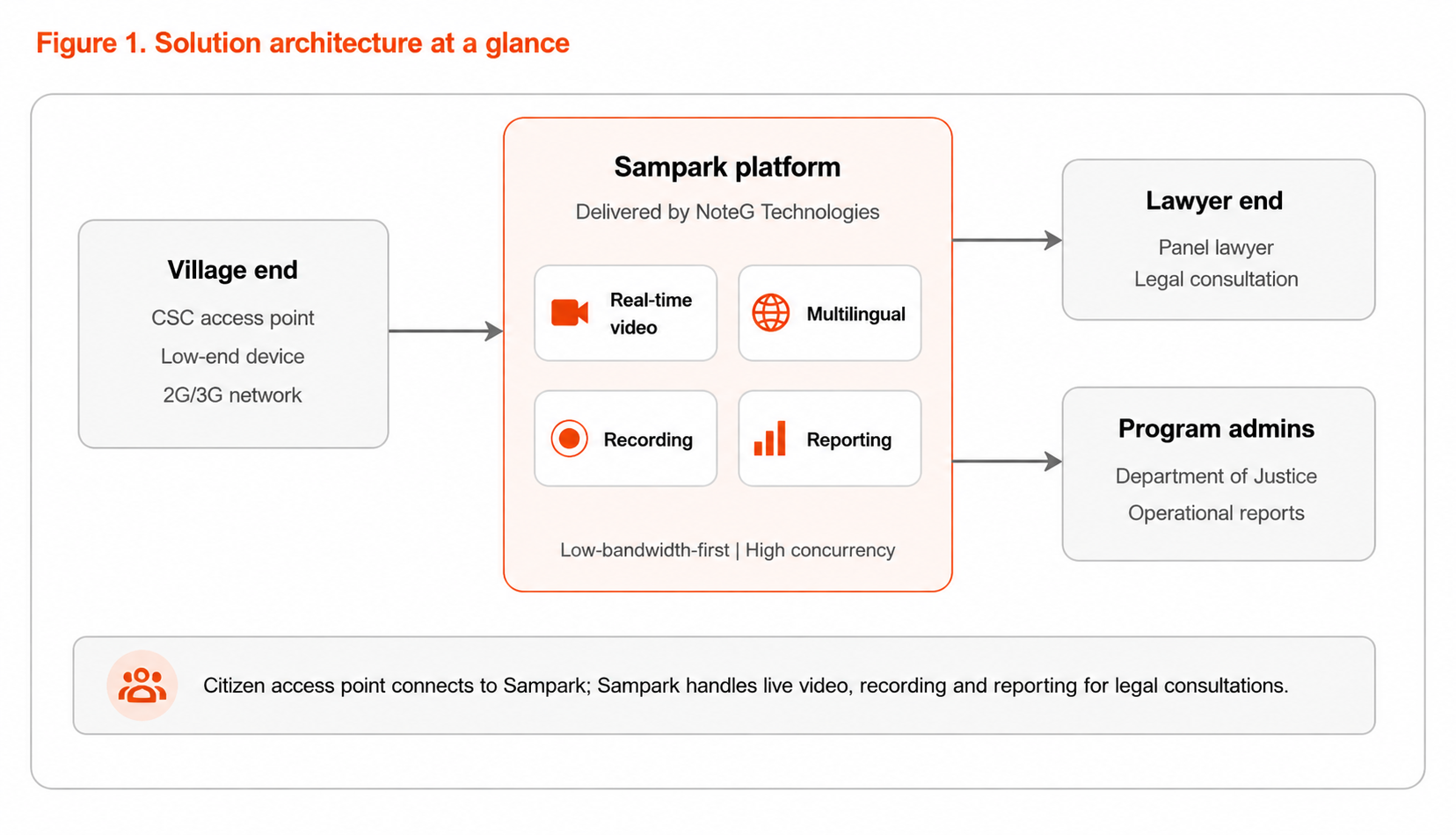
Solution architecture at a glance
- Village end: CSC access point, low-end device, 2G/3G network
- Sampark platform: real-time video, multilingual support, recording, reporting, low-bandwidth-first and high concurrency
- Lawyer end: panel lawyer legal consultation
- Program admins: Department of Justice operational reports
| Component | What it does | Delivered by us |
|---|---|---|
| Real-time video layer (Sampark) | Live citizen-lawyer consultations over 2G/3G and low-end devices. | Built + integrated |
| Multilingual support | Consultations across multiple languages. | Built in |
| Session recording | Verifiable record of consultations. | Built |
| Reporting | Operational visibility for program administrators. | Built |
5. End-to-end consultation workflow
How a Tele-Law consultation moves from village access to legal guidance
The consultation flow begins at the citizen's local CSC and ends with actionable guidance plus program-level reporting. The platform is designed so that the citizen-facing experience remains simple while the operational layer keeps records, reporting and accountability intact.
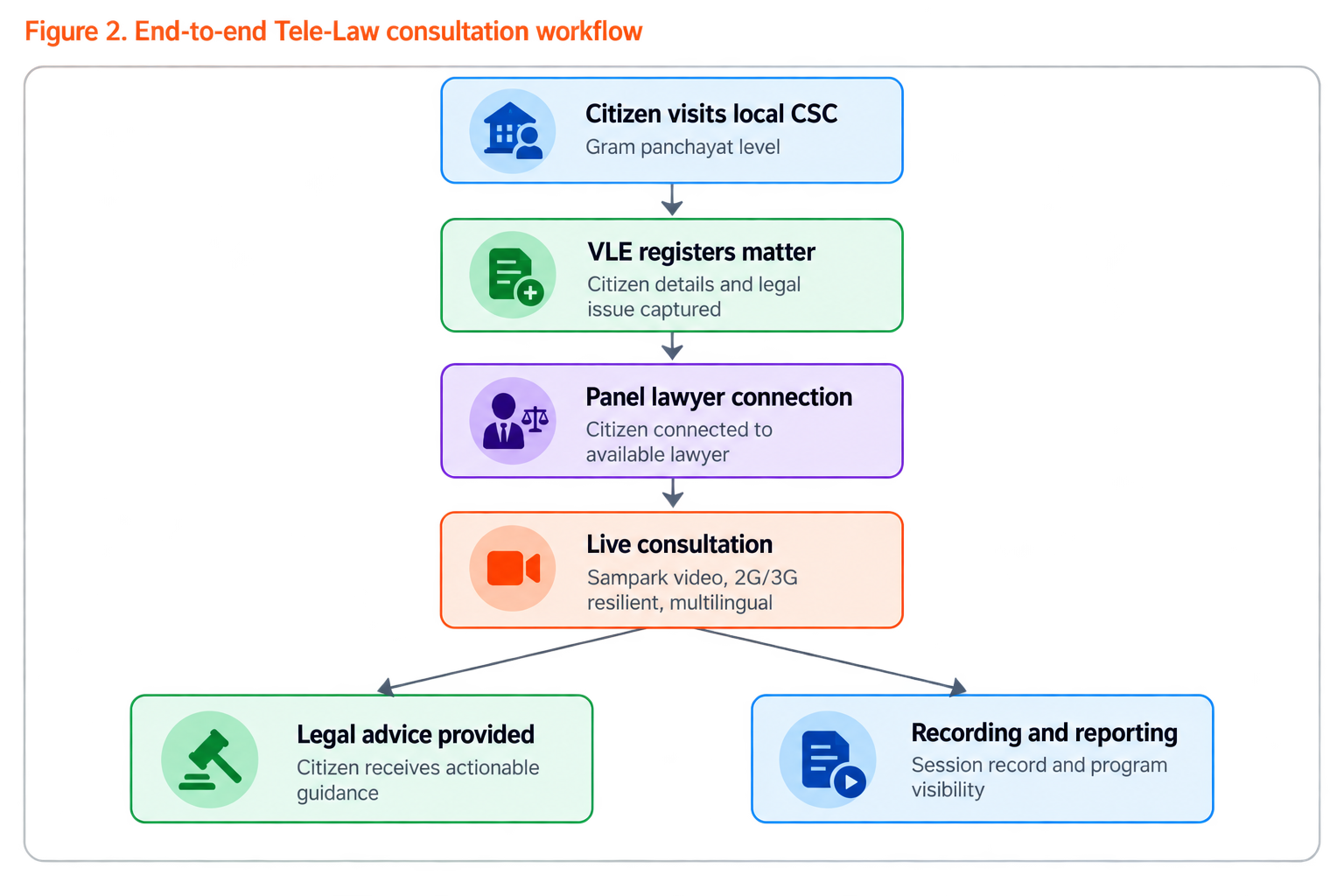
- 1Citizen visits local CSC at gram panchayat level.
- 2VLE registers the citizen's matter and initiates access to consultation.
- 3Citizen is connected to a panel lawyer through Sampark.
- 4Legal advice is delivered; session is recorded; activity flows into reporting.
6. Implementation methodology
Engineering for the last mile
The defining methodology behind Sampark in this engagement was low-bandwidth-first engineering. Instead of assuming urban broadband and degrading poorly in rural conditions, the system assumes constrained networks and adapts upward when connectivity improves.
- Assume the weakest network first: media handling is tuned so the call remains functional at very low bandwidth, improving quality only when the network allows.
- Degrade gracefully: under network stress, continuity of consultation is prioritized over cosmetic video quality.
- Respect the access device: client behavior is kept lightweight so the program does not depend on expensive equipment at village access points.
| Requirement | Design response |
|---|---|
| Unstable 2G/3G connectivity | Adaptive real-time handling and low-bandwidth-first call behavior. |
| Low-cost CSC hardware | Lightweight client approach to reduce compute and device pressure. |
| Diverse citizen languages | Multilingual consultation support as a core requirement. |
| Public service accountability | Session recording and reporting integrated with the consultation activity. |
7. Governance, recording and reporting
Making real-time consultation measurable and auditable
For a national public-service program, delivery is not complete when the call connects. Administrators also need evidence, usage visibility and operational feedback. The supplied case material identifies session recording and reporting as delivered components of the platform.
| Governance layer | Function |
|---|---|
| Session recording | Creates a verifiable record of consultations, supporting accountability, quality review and program integrity. |
| Structured reporting | Turns consultation activity into operational visibility for program administrators. |
| Usage monitoring | Supports understanding of active users, consultation volume and sustained platform load. |
| Program improvement | Enables data-informed review rather than anecdotal monitoring alone. |
Accountability principle: the platform treats every consultation as both a citizen service interaction and an operational event. That dual view helps the program serve citizens while preserving the management visibility needed for a nationwide government initiative.
8. Results and impact
Production-scale usage under constrained conditions
The delivered platform is described as running in production after delivery in 2025. The outcomes below reflect sustained use, not a pilot deployment.
| Impact dimension | Observed outcome |
|---|---|
| Access continuity | Consultations can complete in areas where conventional video tools may fail. |
| Operational scale | High daily consultation volumes are supported across a national program environment. |
| Device inclusivity | The solution works with low-end devices, reducing infrastructure barriers at CSC points. |
| Language inclusivity | Multilingual consultation support aligns with citizen diversity. |
| Administrative confidence | Recording and reporting provide evidence and visibility for program governance. |
The case shows real-time legal access operating at national scale while meeting the practical realities of rural networks, modest hardware and government accountability expectations.
9. Discussion and strategic significance
Why this case matters for public digital infrastructure
The Tele-Law engagement matters because it combines social importance with hard engineering constraints. It is not enough for the platform to work in ideal conditions; it must work where legal access is hardest to deliver.
| Finding | Interpretation |
|---|---|
| Hardest version of real-time communication | Video must work over weak rural connectivity, not only in urban broadband settings. |
| Public-infrastructure trust | The platform supports a flagship national program where reliability, evidence and reporting are essential. |
| Mission-critical continuity | A completed consultation can determine whether a citizen receives timely legal advice. |
| Reusable capability proof | The same low-bandwidth-first communication approach is relevant to healthcare, advisory, education and public-service platforms. |
This case positions Sampark as a real-time platform built for constrained environments: weak networks, modest devices, multilingual users and high-consequence public-service sessions. That combination is central to digital inclusion work across India and other emerging public infrastructure contexts.
10. Conclusion
A national-scale proof point for reliable real-time public service delivery
The Tele-Law case study demonstrates how NoteG Technologies delivered the real-time backbone for a public access-to-justice program. Through Sampark, citizens at village-level CSCs can connect with panel lawyers over a platform engineered for rural connectivity, low-end devices, multilingual use and sustained national-scale concurrency.
The engagement also shows that real-time communication in public infrastructure must be evaluated differently from ordinary consumer video. The most important measure is not the prettiest call under ideal conditions, but the ability to complete a meaningful consultation when the network is weak, the device is modest and every session matters.
- Core proof point: real-time legal consultation can be delivered reliably across rural 2G/3G networks and low-end access devices.
- Operational proof: 250,000+ monthly active users and around 10,000 consultation calls per day show sustained production use.
- Governance proof: session recording and reporting make the program measurable, reviewable and accountable.
- Capability proof: Sampark demonstrates NoteG Technologies' ability to deliver real-time infrastructure for high-stakes public programs.
Capability proof
Sampark demonstrates NoteG Technologies' ability to deliver real-time infrastructure for high-stakes public programs under rural network, device and language constraints.
Join Our Newsletter & Get updated.
We only send interesting and relevant emails.
We deliver reliable technology solutions for clients across India and international markets. All engagements are governed by clear contracts and service-level agreements defining scope, timelines, and responsibilities.